English ∨
 中文
中文
OpenAI Model Disproves 80-Year-Old Classic Mathematical Conjecture, Shocks Academic Community
2026-06-02 23:28:21
63
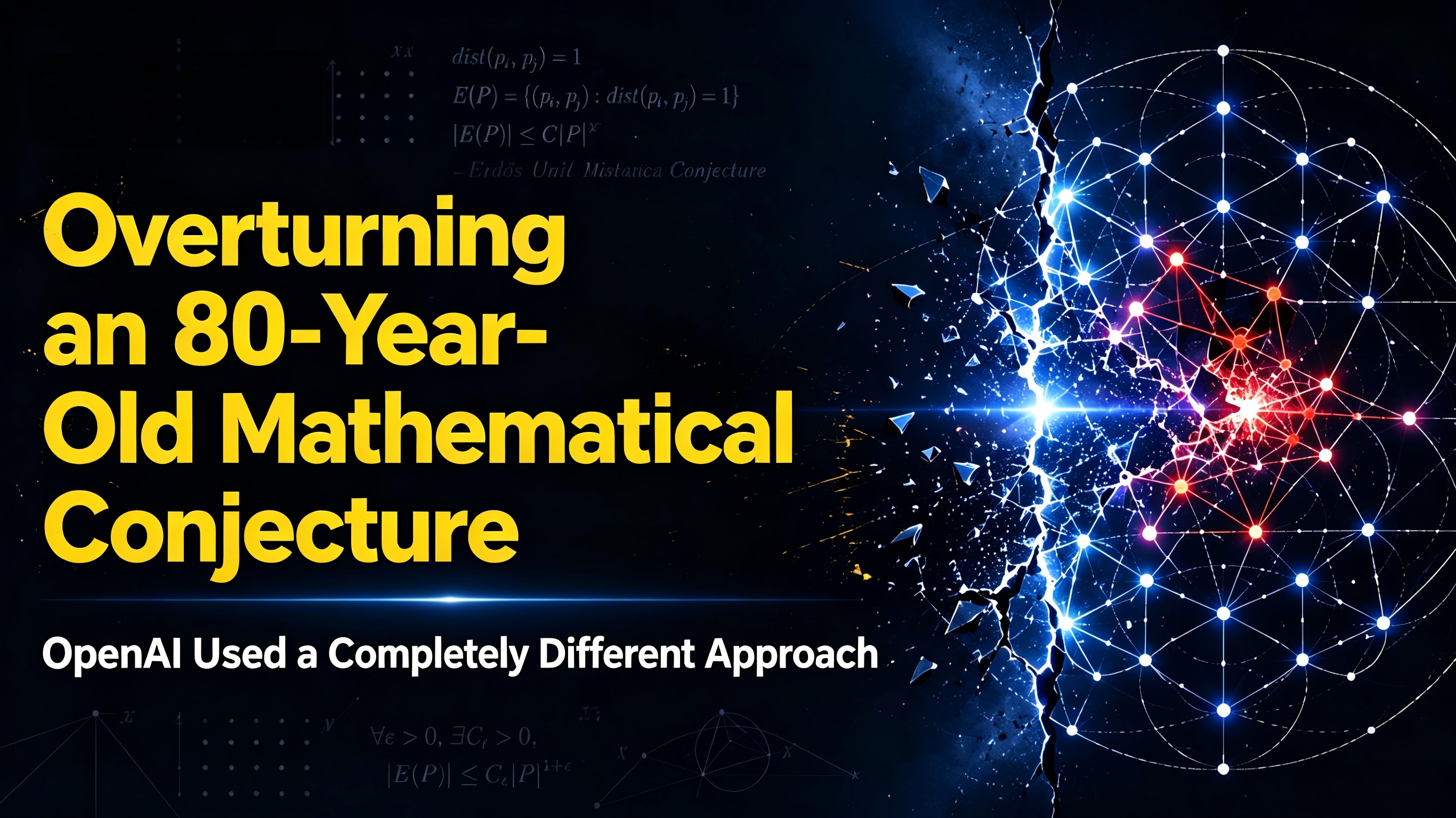
OpenAI recently claimed a major breakthrough in AI reasoning: its artificial intelligence has solved an 80-year-old puzzle—the unit distance problem in the plane posed by Hungarian mathematician Paul Erdős in 1946.
Erdős’s question is: If you draw a number of points on a piece of paper, how many pairs of points can be exactly the same distance apart (specifically, one unit distance)? Erdős proved that arranging points in a grid yields a large number of unit-distance pairs. He then conjectured that no other arrangement could do significantly better.
For decades, people have tried to prove the conjecture correct. However, OpenAI’s model reached a different conclusion, showing that arrangements exist that exceed Erdős’s predicted upper bound. This means the AI did not prove the conjecture—it disproved it.
The OpenAI research team argued that AI will not eliminate mathematical research; instead, it will expand humanity’s ability to explore the unknown. In fact, mathematicians have already begun using methods from this work to tackle other long-standing unsolved problems.
“We have not yet seen a spark of genius comparable to the greatest proofs in human history,” said OpenAI researcher Sébastien Bubeck. Yet it is increasingly clear that AI is fully capable of advancing genuine scientific discovery.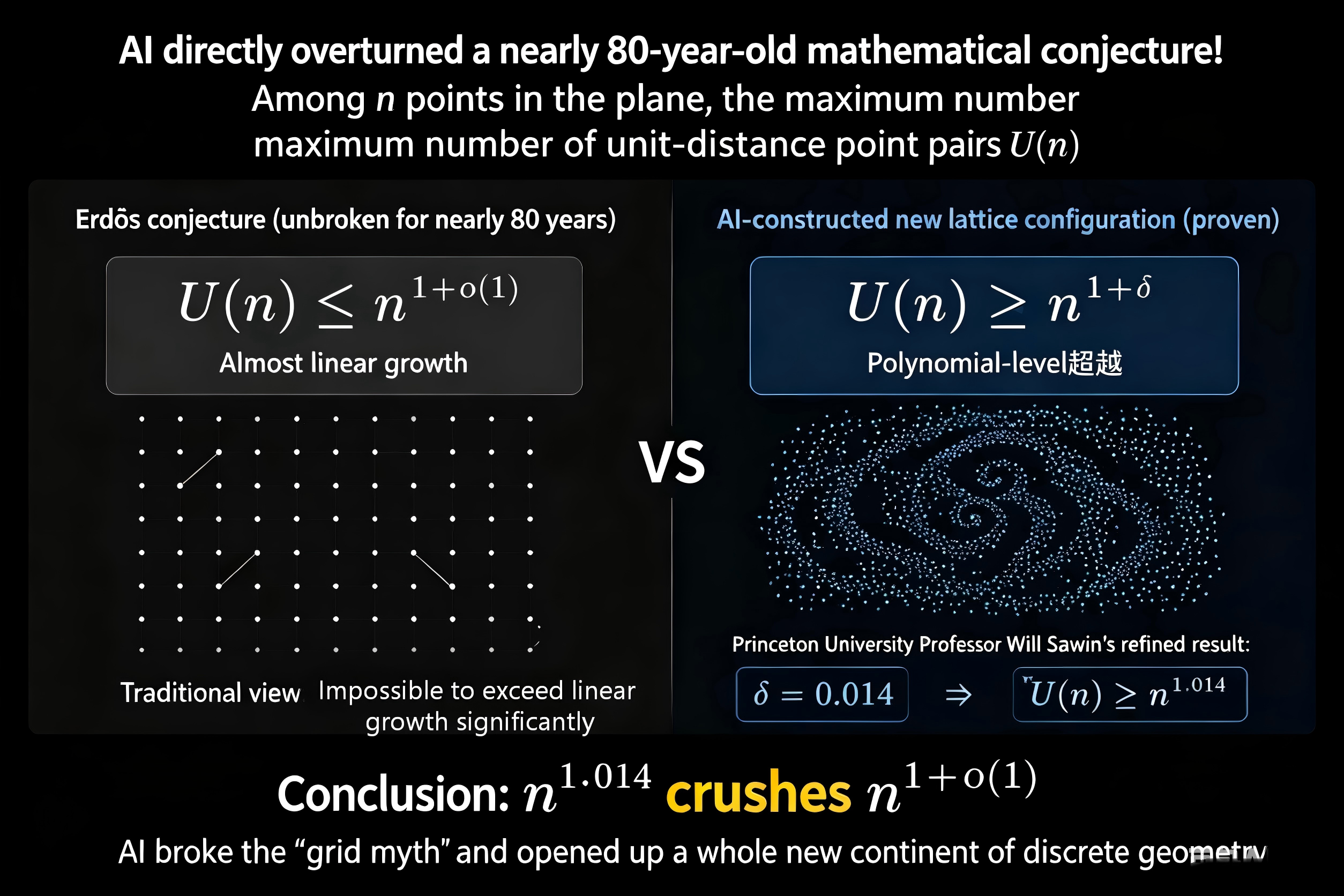
Last Article